


Early Life in the Cape
Frederick John Gee was born in the coastal town of Port Nolloth on January 6, 1913. A man of the Cape, he eventually settled in Goodwood at 18th Kimberley Street. Before the outbreak of World War II, Frederick worked as a handyman, a trade that likely provided the practical, problem-solving skills that would make him an ideal candidate for the Engineering Corps.

Left you can see his ribbon bar above the left pocket. While it’s a bit grainy, at least one of those ribbons likely represents the 1939–1945 Star or the Italy Star, which were standard for the SAEC personnel who served in that theatre. His beret is worn in the classic style of the era, and he certainly looks like a proud Staff Sergeant.
Call to Arms: The 8th Company SAEC
At the age of 27, Frederick stood 5’9” with a fair complexion and brown hair. He officially joined the war effort with the South African Engineer Corps (SAEC), assigned to the 8th Company (Service No. 74893).
His technical aptitude was quickly recognized. While he may have started as a sapper, he rose through the ranks to become a Technical Sergeant ($T/SGT$), eventually attaining the rank of Staff Sergeant (as seen in later photos).
The African Campaign: Suez and Cairo
Frederick’s war began in earnest on June 24, 1940, when he was deployed to the Suez. For over three years, until September 1943, he served across the desert theaters of North Africa and Cairo. As an engineer, his life was one of constant labor—building defenses and maintaining supply lines.
Two photographs capture this era vividly:

Staff Sergeant Frederick John Gee (left) alongside a convoy of South African Engineer Corps (SAEC) Chevrolet 1.5-ton trucks. The “U” registration on the fender (U16920) denotes Union of South Africa service during the North African campaign.

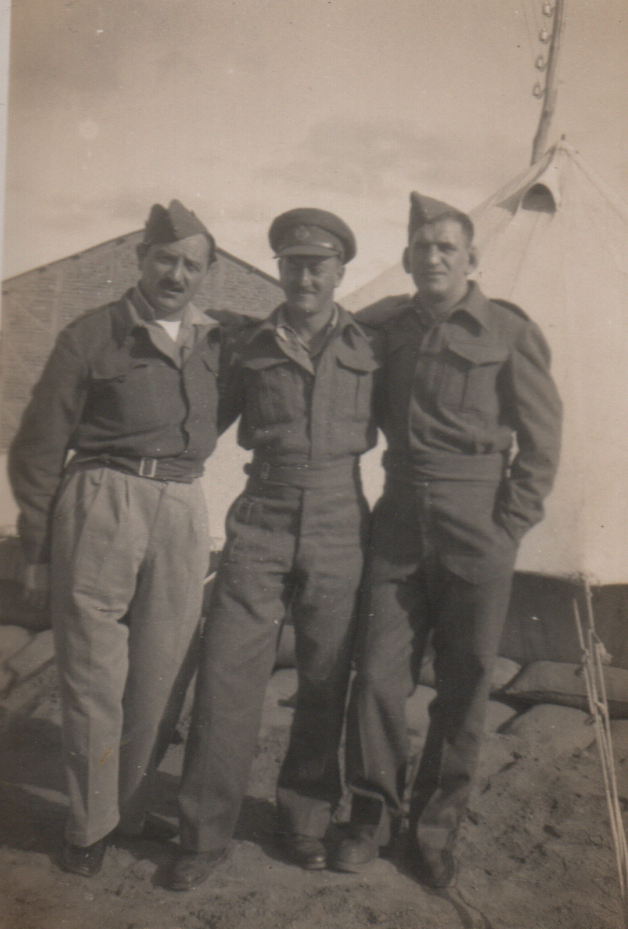
A candid moment of Frederick leaning against a massive wall of sandbags, wearing the “Bombay bloomers” common to South African troops in the Mediterranean.
His service was not without personal cost; during his time in the field, Frederick contracted Malaria, a common but grueling hardship for soldiers serving in those regions.
Victory in Italy
Following the conclusion of the North African campaign, Frederick moved with the Allied advance into Italy. This chapter of his service earned him the Italy Star and provided some of the most iconic images of his collection. After years of desert dust and sandbags, Frederick and his comrades are seen as victors in the historic squares of Venice:
Frederick (marked by his SGT stripes) is pictured relaxing in Piazza San Marco and by the Doge’s Palace, feeding pigeons and taking in the sights of a liberated Europe.
This photo was taken in Piazza San Marco (St. Mark’s Square) in Venice, Italy.
The large building directly behind the group is St. Mark’s Basilica (Basilica di San Marco). You can clearly see its famous domes, arched portals, and intricate facade. The square is also well-known for the large population of pigeons, which the men in the photo are feeding—a classic tourist activity in that location for decades.

Homecoming and Legacy
Frederick returned to South Africa and was officially discharged on July 10, 1946 (corrected from 1940 based on campaign dates). He returned to civilian life and built a family with his wife, Henny de Rouw (born 19-6-16). They had two children: a son, Anthony (born 8-4-49), and a daughter, Penelope Ann (born 1-3-51).
Medal Group & Honors
Frederick’s contribution to the Allied victory is commemorated by a distinguished group of six medals:
- 1939–45 Star
- Africa Star
- Italy Star
- Defence Medal (British)
- War Medal 1939–45
- Africa Service Medal
This archive is a tribute to a South African “Handyman” who answered the call, serving from the ports of the Cape to the canals of Venice.
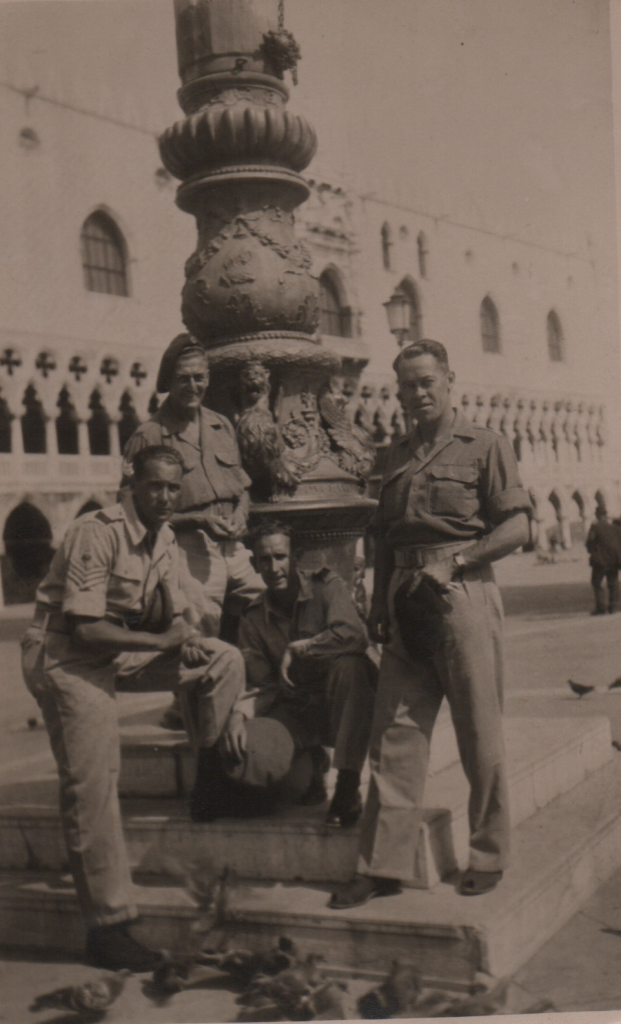
Another wonderful shot from that same trip to Venice!
This photo was taken right in front of the Doge’s Palace (Palazzo Ducale), which you can see in the background with its distinctive Gothic arches and patterned stone walls. Frederick and his group are leaning against one of the ornate bronze flagpole bases (pedestals) in Piazza San Marco.

This is an incredible shot. In this photo above, Frederick (marked with the green X) and his comrades are pictured with their transport—specifically, the trucks behind them appear to be Chevrolet 1.5-ton 4×2 military trucks, which were staples of the Allied motor pools.
A few notable details from this scene:
- Uniform Diversity: Frederick is in his light “summer” or North African/Mediterranean theatre khakis. Interestingly, the officer in the center is wearing a formal dark tunic and a peaked cap while carrying a swagger stick, suggesting this might have been a formal inspection or a moment before a transition between base camps.
- SAEC Markings: If you look closely at the truck on the left, you can see the white military registration numbers (prefixed with ‘U’ for Union of South Africa) and tactical signs on the fenders. These often designated the specific company or battalion within the Engineers.
- The Setting: The open field and the chain-link boundary suggest a more permanent military staging area or a depot, likely in North Africa or a secure area of Italy.
The South African Engineers were often referred to as the “Jills of all trades” because they handled everything from water purification to building the famous Bailey Bridges.
Salute!
