M511 – Sergeant – Frederick John Gee – South African Engineers Corps

Early Life in the Cape

Frederick John Gee was born in the coastal town of Port Nolloth on January 6, 1913. A man of the Cape, he eventually settled in Goodwood at 18th Kimberley Street. Before the outbreak of World War II, Frederick worked as a handyman, a trade that likely provided the practical, problem-solving skills that would make him an ideal candidate for the Engineering Corps.

Frederick John Gee

Left you can see his ribbon bar above the left pocket. While it’s a bit grainy, at least one of those ribbons likely represents the 1939–1945 Star or the Italy Star, which were standard for the SAEC personnel who served in that theatre. His beret is worn in the classic style of the era, and he certainly looks like a proud Staff Sergeant.

Call to Arms: The 8th Company SAEC

At the age of 27, Frederick stood 5’9” with a fair complexion and brown hair. He officially joined the war effort with the South African Engineer Corps (SAEC), assigned to the 8th Company (Service No. 74893).

His technical aptitude was quickly recognized. While he may have started as a sapper, he rose through the ranks to become a Technical Sergeant ($T/SGT$), eventually attaining the rank of Staff Sergeant (as seen in later photos).

The African Campaign: Suez and Cairo

Frederick’s war began in earnest on June 24, 1940, when he was deployed to the Suez. For over three years, until September 1943, he served across the desert theaters of North Africa and Cairo. As an engineer, his life was one of constant labor—building defenses and maintaining supply lines.

Two photographs capture this era vividly:

Staff Sergeant Frederick John Gee (left) alongside a convoy of South African Engineer Corps (SAEC) Chevrolet 1.5-ton trucks. The “U” registration on the fender (U16920) denotes Union of South Africa service during the North African campaign.

A candid moment of Frederick leaning against a massive wall of sandbags, wearing the “Bombay bloomers” common to South African troops in the Mediterranean.

His service was not without personal cost; during his time in the field, Frederick contracted Malaria, a common but grueling hardship for soldiers serving in those regions.

Victory in Italy

Following the conclusion of the North African campaign, Frederick moved with the Allied advance into Italy. This chapter of his service earned him the Italy Star and provided some of the most iconic images of his collection. After years of desert dust and sandbags, Frederick and his comrades are seen as victors in the historic squares of Venice:

Frederick (marked by his SGT stripes) is pictured relaxing in Piazza San Marco and by the Doge’s Palace, feeding pigeons and taking in the sights of a liberated Europe.

This photo was taken in Piazza San Marco (St. Mark’s Square) in Venice, Italy.

The large building directly behind the group is St. Mark’s Basilica (Basilica di San Marco). You can clearly see its famous domes, arched portals, and intricate facade. The square is also well-known for the large population of pigeons, which the men in the photo are feeding—a classic tourist activity in that location for decades.

Homecoming and Legacy

Frederick returned to South Africa and was officially discharged on July 10, 1946 (corrected from 1940 based on campaign dates). He returned to civilian life and built a family with his wife, Henny de Rouw (born 19-6-16). They had two children: a son, Anthony (born 8-4-49), and a daughter, Penelope Ann (born 1-3-51).

Medal Group & Honors

Frederick’s contribution to the Allied victory is commemorated by a distinguished group of six medals:

  1. 1939–45 Star
  2. Africa Star
  3. Italy Star
  4. Defence Medal (British)
  5. War Medal 1939–45
  6. Africa Service Medal

This archive is a tribute to a South African “Handyman” who answered the call, serving from the ports of the Cape to the canals of Venice.
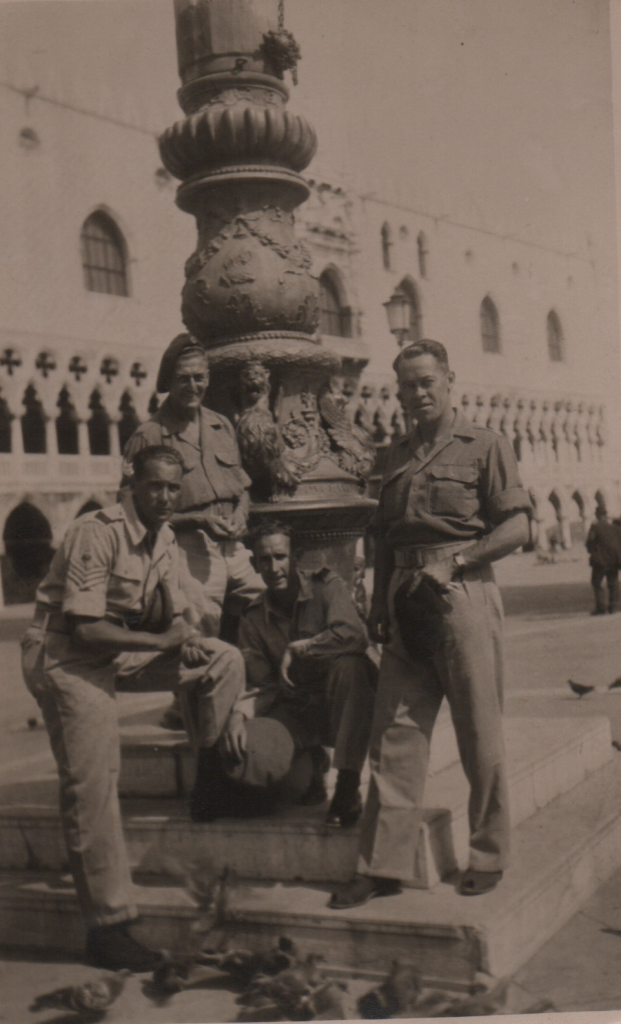
Another wonderful shot from that same trip to Venice!

This photo was taken right in front of the Doge’s Palace (Palazzo Ducale), which you can see in the background with its distinctive Gothic arches and patterned stone walls. Frederick and his group are leaning against one of the ornate bronze flagpole bases (pedestals) in Piazza San Marco.

This is an incredible shot. In this photo above, Frederick (marked with the green X) and his comrades are pictured with their transport—specifically, the trucks behind them appear to be Chevrolet 1.5-ton 4×2 military trucks, which were staples of the Allied motor pools.

A few notable details from this scene:

  • Uniform Diversity: Frederick is in his light “summer” or North African/Mediterranean theatre khakis. Interestingly, the officer in the center is wearing a formal dark tunic and a peaked cap while carrying a swagger stick, suggesting this might have been a formal inspection or a moment before a transition between base camps.
  • SAEC Markings: If you look closely at the truck on the left, you can see the white military registration numbers (prefixed with ‘U’ for Union of South Africa) and tactical signs on the fenders. These often designated the specific company or battalion within the Engineers.
  • The Setting: The open field and the chain-link boundary suggest a more permanent military staging area or a depot, likely in North Africa or a secure area of Italy.

The South African Engineers were often referred to as the “Jills of all trades” because they handled everything from water purification to building the famous Bailey Bridges.
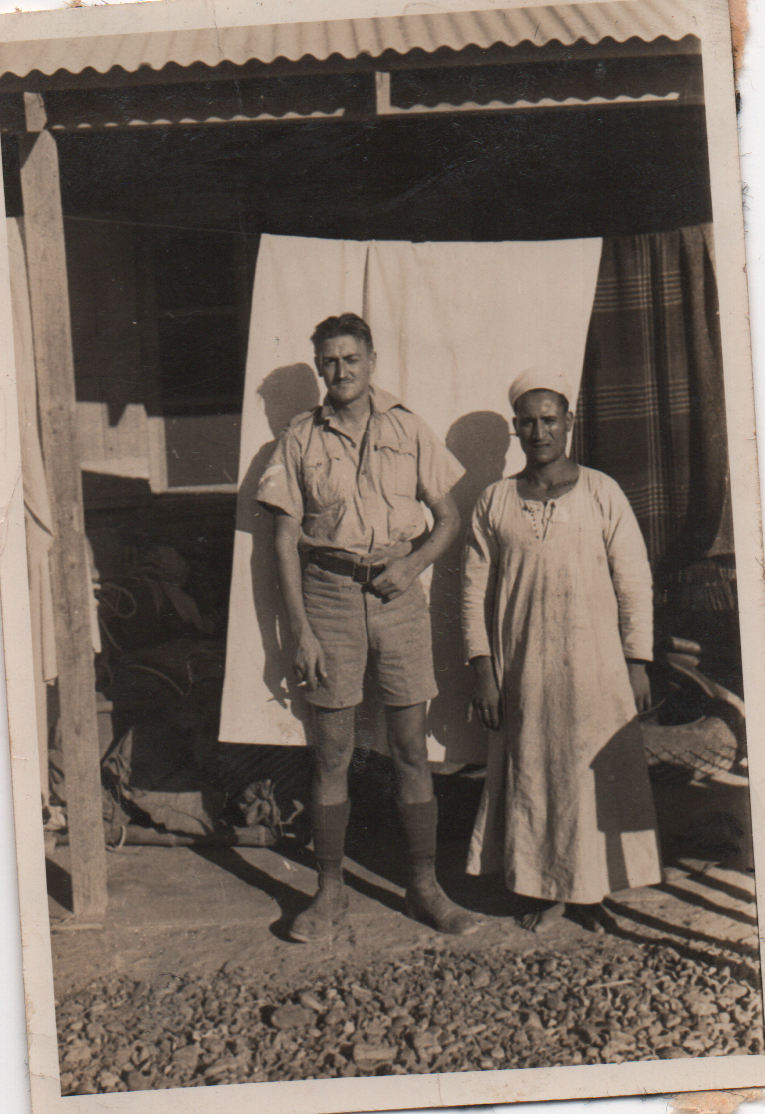
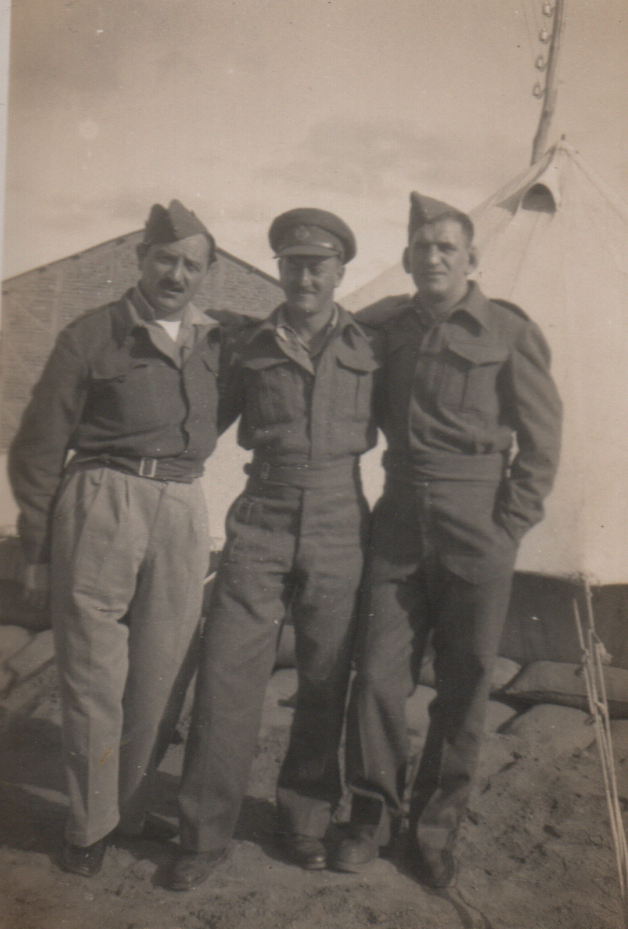
Salute!

Bernard de Rockstro Malraison

Bernard de Rockstro Malraison was a prominent figure in late 19th and early 20th-century Johannesburg, contributing significantly to both the city’s cricketing heritage and its military history.

Early Life and Arrival in Johannesburg

Details about Bernard’s early life remain scarce, but he was among the early European settlers who arrived in Johannesburg following the discovery of gold in the Witwatersrand. Like many of his contemporaries, he was drawn to the burgeoning mining town, seeking opportunities amidst the rapid urban development.wandererscricket.co.za

Founding Member of the Wanderers Cricket Club

In 1888, Bernard de Rockstro Malraison became one of the founding members of the Wanderers Cricket Club, established by a group of young rugby players who had migrated to Johannesburg from other mining towns like Kimberley. The club was formed during a period when Johannesburg was rapidly expanding, and its founders sought to create a space for social and sporting activities. The Wanderers Cricket Club quickly became a central institution in the city’s sporting community, providing a venue for cricket matches and other events. The club’s grounds, known as the Old Wanderers Ground, hosted 22 Test matches from 1895 to 1939 before being redeveloped in 1946 .wandererscricket.co.zaWikipedia

Military Service and the Second Boer War

During the Second Boer War (1899–1902), Bernard de Rockstro Malraison served with distinction. While specific details of his military engagements are limited, his involvement in the conflict places him among the many who contributed to the defense of the South African Republic during this tumultuous period. The war was marked by significant battles, including the Battle of Doornkop near Johannesburg, where British forces clashed with Boer commandos .Anglo Boer War

Legacy and Family

Bernard’s legacy continued through his son, William Henry de Rockstro Malraison, who followed in his father’s footsteps both in cricket and military service. William played first-class cricket for Transvaal in the 1904/05 season, appearing in two matches during the Currie Cup. He later served with the South African Army in the 1st South African Horse during World War I and tragically died on May 31, 1916, from fever while serving in German East Africa. He was buried at the Dar es Salaam Cemetery .Wikipedia

Through his contributions to Johannesburg’s cricketing community and his service during the Second Boer War, Bernard de Rockstro Malraison played a pivotal role in the city’s development during a formative period in South African history.

Death over the Bulge – Lt. Antony Ewart Collett SAAF

50 Years on, an old pilot provides a footnote to history, and Robert Ball recalls the Collett tragedy.

SEPTEMBER 24 1944. Typhoon 1B. R(ocket) P(rojectile) and cannon in support of paratroops west of Arnhem. Attacked according to plan. Paratroops in a bad way. No Flak.

-Lt. Athol Fisher

THIS excerpt from the logbook of a South African pilot seconded to the RAF, recalls the Battle of Arnhem, 50 years ago, when 10000 Allied paratroopers landed to capture a key bridge on the Rhine, with disastrous consequences.

The battle was the subject of the film A Bridge too Far. Only 2 400 paratroops returned. The rest were killed or captured.

This week, while Prince Charles and the Queen of the Netherlands paid tribute to the heroes of that action, an Eastern Cape family turned their thoughts once more to their own tragic loss. The pilot who kept that logbook, their brother and uncle, flew in support of those paratroopers and was himself to perish three months later, ending a life which had seemed so full of promise.

From all accounts,

Antony Ewart Collett, known as Tony, was a remarkable young man.

Serviceman… A photograph taken during the war of three Eastern Cape servicemen. From left Supply Petty Officer WJ van Deventer, then of 40 Alcock Road, Walmer, 2nd Lt. Tony Collett of Dunblane Middelburg, Cape and 3rd Officer AL Miller of Jeffreys Bay. The picture was taken during the BBC programmer Songtime in the Laager, which was broadcast weekly from London in the BBC’s African shortwave service. Can anybody tell the Herald what became of Miller and van Deventer?

Of 1820 Settler stock and the younger son of Col Ewart Collett CMG DSO, a distinguished South African officer in the South African War and First World War, he grew up in Port Elizabeth and on the family farm, Dunblane, at Middelburg, Cape,

At St Andrew’s in Grahamstown he won colours for five sports — rugby, cricket, hockey, athletics and tennis, a feat equalled by only three others in the history of the school.

Despite all that activity, his academic record was good, and there was little doubt that he was destined to be a St. Andrew’s Rhodes Scholar and go to Oxford. But even before he left school, the Second World War had intervened.

Typically, the 1,87m 80kg 17-year-old chose the most exciting option – he wanted to fly.

And he was flying when he died. 

It was a tragedy that still haunts his family and his friends. 

For the rest of her life, his widowed mother kept his tasselled rugby cap on her bedpost. His elder brother David and his sisters, Grace and Ena, never ceased to mourn him and his memory has been kept alive by his many nephews and nieces, most of whom hardly remember him, if they are old enough to have known him at all.

One nephew is Andy Collett, who now lives in Port Elizabeth and who bears an extraordinary resemblance to Tony.Andy, too, has an almost obsessive interest in flying.

Nephew… Andy Collett, right of Port Elizabeth, who has finally tracked down a witness of his pilot uncle’s death in the Second World War.

He is the custodian of his uncle’s memorabilia. Over the years he has used his uncle’s logbook to trace flying contacts and records. Tony joined up in 1942, training in the SAAF and receiving his wings from “Ouma” Smuts herself.

Then he was seconded to the Royal Air Force, necessitating a long roundabout journey to England, via Montevideo where he wrote home about seeing the wreck of the Graf Spee, the German pocket battleship so dramatically scuttled after the Battle of the River Plate in the early days of the war.

Clearly, the RAF thought highly of Tony’s abilities. Andy has their assessments of him – an above average pilot who was exceptional at bombing and an above average gunner.

At Arnhem, Tony’s unit, 184 Squadron, gave anti-flak support to Dakotas carrying in paratroopers and later covered the aircraft when they brought in supplies. It was a tough job and hard to do much in the terrible weather.

Tony’s friend, Dermot Quick of Grahamstown, a fellow member of the squadron, says: “The Dakotas were being knocked down like flies.”

At different times in the war, Tony flew Hurricanes, Spitfires, then Typhoons. And it was in a Typhoon that he was to die, not long after Arnhem and just short of his 21st birthday.

His logbook, now Andy’s treasured possession, closes with the words Missing in Action in red ink.

Last Picture… Lt. Antony Collett SAAF, left with fellow 184 Squadron airmen at Volkel, Holland, in December 1944, shortly before he was killed in action. Others in the picture are, from left, Squadron Leader W Smith, the squadron adjutant whose name was Frew, Lt. Athol Fisher of Kimberley who witnessed Collett’s death, Lt. James Himiona Wetere DFC a Māori from New Zealand.

After the war, the family was told where Tony was buried. Andy’s elder brother, the Rev Ewart Collett, of Port Alfred, has visited and photographed the grave in Rheinberg, Germany. But they did not know the circumstances of his death. Now Andy, through Quick, has traced Athol Fisher of Kimberley who was part of that last operation and who witnessed Tony’s final moments.

The date was December 27, 1944, during the Battle of the Bulge which began when the Germans broke back through the American lines.

Tony’s squadron was supporting the 51st Highland Division, sent by Montgomery to help. Quick says the squadron was facing conditions so tough that the Americans grounded their own aircraft.

From his own aircraft, Fisher saw Tony’s death. “I saw him and another Typhoon pilot, a Canadian, I think, come from two different directions, locked on the same target. They collided and were lost in the explosion.”

Only a few minutes later, Fisher was himself shot down and taken prisoner. He was treated for burns and injured his back. He was held for the rest of the war, having a tough time as Germans had little food. He lost nearly 20kg. It was to be nearly 50 years before Andy contacted him to hear that account.

Quick says that for the two remaining South Africans in the squadron, December 27 was a black day indeed when Collett and Fisher did not come back. Only much later did they hear that Fisher was still alive.

Today, at 70, Fisher has had a happy life in Kimberley. He still works and is active in the Air

Force Association and the SA Legion. And he’s proud to say that his son is a pilot, too. Fisher remembers Tony Collett well. “A fine chap. A gentle gi-ant, full of laughter.”

As for Quick, his war service ended in March 1945 when he was knocked down over the Rhine while supporting paratroopers. He was badly burnt and was in hospital undergoing plastic surgery from then until October, when he returned to South Africa. In 1960 he came to Grahamstown where he is now retired. Today, Quick recalls Tony as “the greatest guy I ever knew” In war conditions, he says, Tony was the best man to have around, one who didn’t brood on the risk of being killed. “What happens, happens,” Tony used to say. It did. But that fine young man lives on in many hearts.

Eastern Province Herald (Port Elizabeth, South Africa) 23 September 1994

css.php