M511 – Sergeant – Frederick John Gee – South African Engineers Corps

Early Life in the Cape

Frederick John Gee was born in the coastal town of Port Nolloth on January 6, 1913. A man of the Cape, he eventually settled in Goodwood at 18th Kimberley Street. Before the outbreak of World War II, Frederick worked as a handyman, a trade that likely provided the practical, problem-solving skills that would make him an ideal candidate for the Engineering Corps.

Frederick John Gee

Left you can see his ribbon bar above the left pocket. While it’s a bit grainy, at least one of those ribbons likely represents the 1939–1945 Star or the Italy Star, which were standard for the SAEC personnel who served in that theatre. His beret is worn in the classic style of the era, and he certainly looks like a proud Staff Sergeant.

Call to Arms: The 8th Company SAEC

At the age of 27, Frederick stood 5’9” with a fair complexion and brown hair. He officially joined the war effort with the South African Engineer Corps (SAEC), assigned to the 8th Company (Service No. 74893).

His technical aptitude was quickly recognized. While he may have started as a sapper, he rose through the ranks to become a Technical Sergeant ($T/SGT$), eventually attaining the rank of Staff Sergeant (as seen in later photos).

The African Campaign: Suez and Cairo

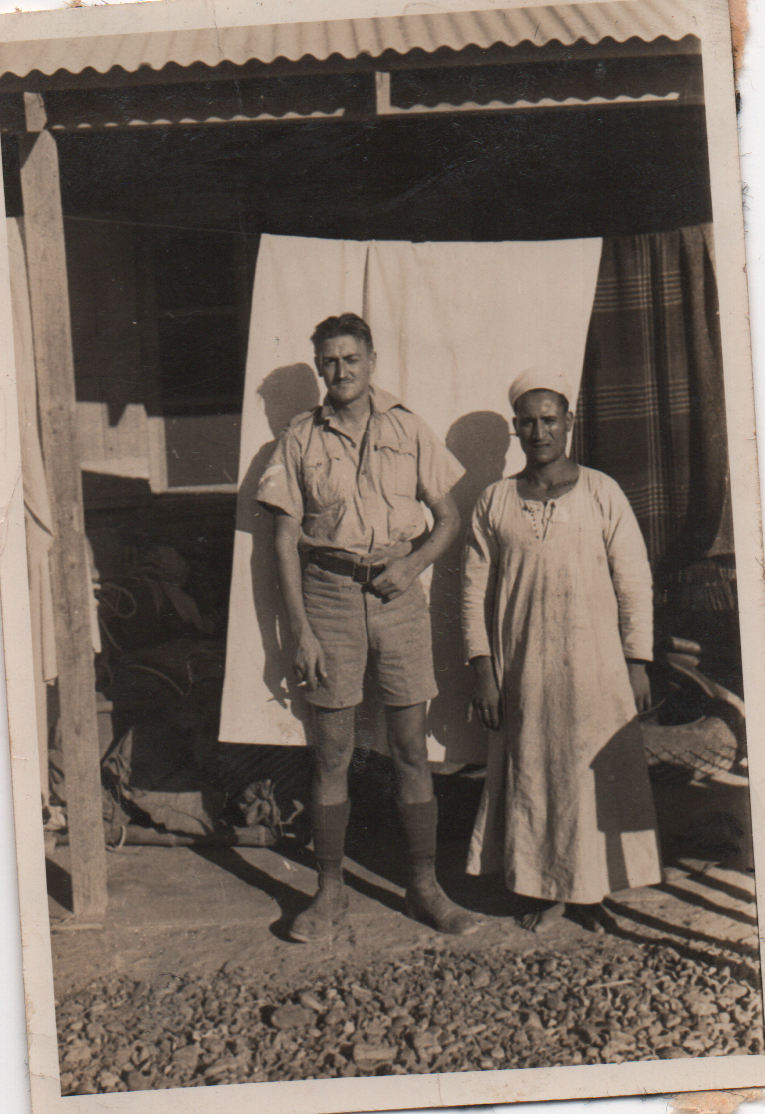
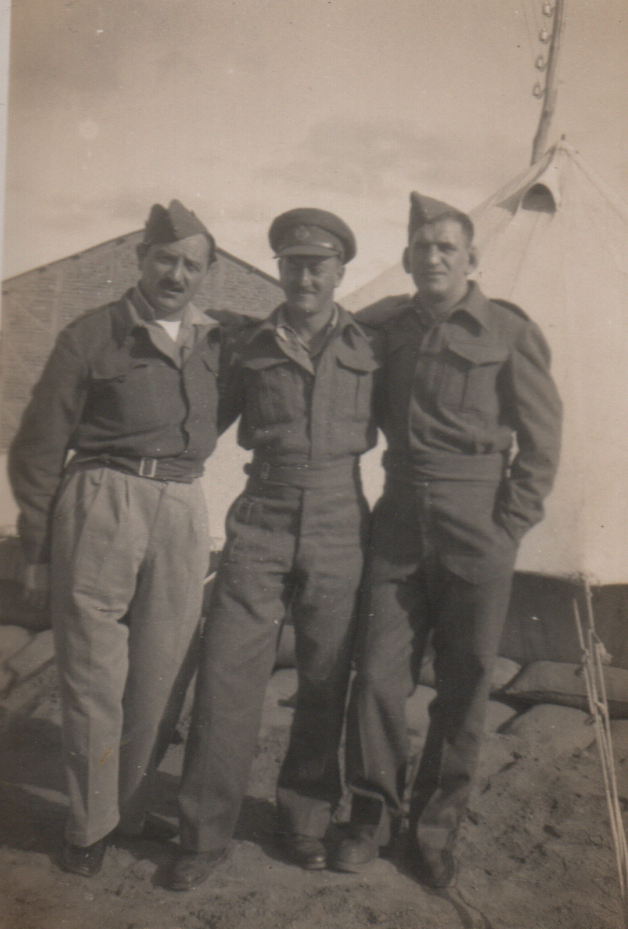
Frederick’s war began in earnest on June 24, 1940, when he was deployed to the Suez. For over three years, until September 1943, he served across the desert theaters of North Africa and Cairo. As an engineer, his life was one of constant labor—building defenses and maintaining supply lines.

Two photographs capture this era vividly:

Staff Sergeant Frederick John Gee (left) alongside a convoy of South African Engineer Corps (SAEC) Chevrolet 1.5-ton trucks. The “U” registration on the fender (U16920) denotes Union of South Africa service during the North African campaign.

A candid moment of Frederick leaning against a massive wall of sandbags, wearing the “Bombay bloomers” common to South African troops in the Mediterranean.

His service was not without personal cost; during his time in the field, Frederick contracted Malaria, a common but grueling hardship for soldiers serving in those regions.

Victory in Italy

Following the conclusion of the North African campaign, Frederick moved with the Allied advance into Italy. This chapter of his service earned him the Italy Star and provided some of the most iconic images of his collection. After years of desert dust and sandbags, Frederick and his comrades are seen as victors in the historic squares of Venice:

Frederick (marked by his SGT stripes) is pictured relaxing in Piazza San Marco and by the Doge’s Palace, feeding pigeons and taking in the sights of a liberated Europe.

This photo was taken in Piazza San Marco (St. Mark’s Square) in Venice, Italy.

The large building directly behind the group is St. Mark’s Basilica (Basilica di San Marco). You can clearly see its famous domes, arched portals, and intricate facade. The square is also well-known for the large population of pigeons, which the men in the photo are feeding—a classic tourist activity in that location for decades.

Homecoming and Legacy

Frederick returned to South Africa and was officially discharged on July 10, 1946 (corrected from 1940 based on campaign dates). He returned to civilian life and built a family with his wife, Henny de Rouw (born 19-6-16). They had two children: a son, Anthony (born 8-4-49), and a daughter, Penelope Ann (born 1-3-51).

Medal Group & Honors

Frederick’s contribution to the Allied victory is commemorated by a distinguished group of six medals:

  1. 1939–45 Star
  2. Africa Star
  3. Italy Star
  4. Defence Medal (British)
  5. War Medal 1939–45
  6. Africa Service Medal

This archive is a tribute to a South African “Handyman” who answered the call, serving from the ports of the Cape to the canals of Venice.
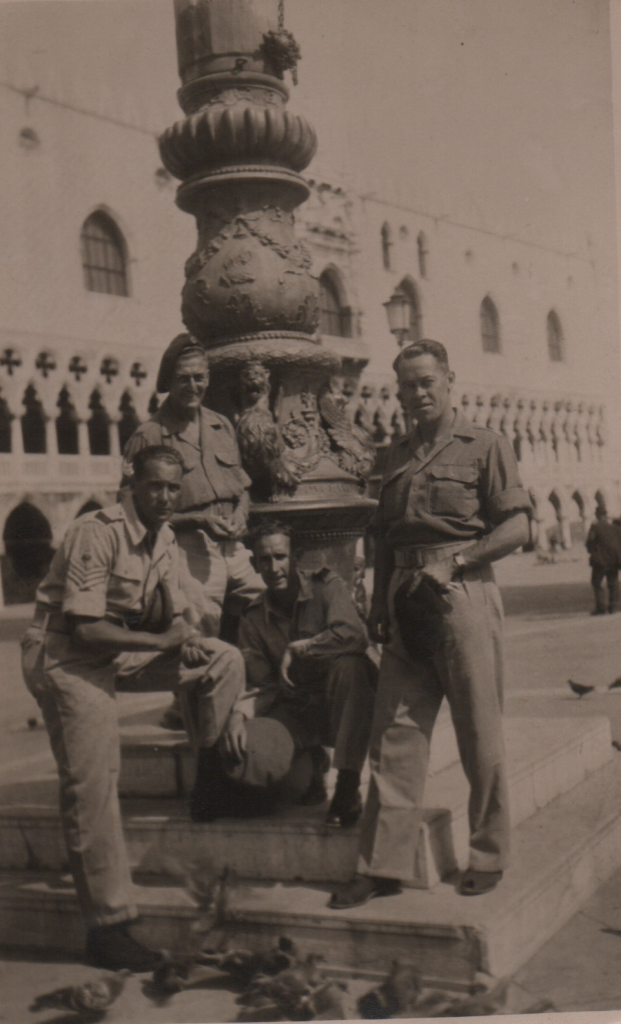
Another wonderful shot from that same trip to Venice!

This photo was taken right in front of the Doge’s Palace (Palazzo Ducale), which you can see in the background with its distinctive Gothic arches and patterned stone walls. Frederick and his group are leaning against one of the ornate bronze flagpole bases (pedestals) in Piazza San Marco.

This is an incredible shot. In this photo above, Frederick (marked with the green X) and his comrades are pictured with their transport—specifically, the trucks behind them appear to be Chevrolet 1.5-ton 4×2 military trucks, which were staples of the Allied motor pools.

A few notable details from this scene:

  • Uniform Diversity: Frederick is in his light “summer” or North African/Mediterranean theatre khakis. Interestingly, the officer in the center is wearing a formal dark tunic and a peaked cap while carrying a swagger stick, suggesting this might have been a formal inspection or a moment before a transition between base camps.
  • SAEC Markings: If you look closely at the truck on the left, you can see the white military registration numbers (prefixed with ‘U’ for Union of South Africa) and tactical signs on the fenders. These often designated the specific company or battalion within the Engineers.
  • The Setting: The open field and the chain-link boundary suggest a more permanent military staging area or a depot, likely in North Africa or a secure area of Italy.

The South African Engineers were often referred to as the “Jills of all trades” because they handled everything from water purification to building the famous Bailey Bridges.
Salute!

Commandant Siegfried van Lier

Johannesburg Vrijwilliger Corps & ZARPs

Early Role

Siegfried van Lier served as 1st Lieutenant Quartermaster for the Staff of Infantry in the Johannesburg Vrijwilliger Corps (JVC) and during the Anglo-Boer War as Lieutenant . He also held the position of Artillery Lieutenant in the Johannesburg Police Corps (ZARPs), one of the most famous and disciplined units of the Zuid-Afrikaansche Republiek (ZAR). His leadership placed him at the forefront of some of the fiercest battles of the war.

Battle of Berg-en-Dal (Dalmanutha), 27 August 1900

Commandant van Lier played a central role during the last pitched battle of the Anglo-Boer War at Berg-en-Dal. Alongside Commandant Ph.R. Oosthuizen and Lieutenant F. Pohlman, van Lier commanded a detachment of only 60–70 men positioned on an isolated kopje. Facing overwhelming odds, their small unit endured:

  • Bombardment from over 40 heavy artillery pieces, including lyddite shells and Maxim fire.
  • A direct assault by 1,500–2,000 British troops, advancing in a semicircle under cover of fire.

Early on the morning of the 27th, Inspector Kommandant P.R. Oosthuizen and S. Van Lier (ZARPs) occupy trenches dug during the night. From there, the commanders go to the front guard post of the police on the hill. The group sat quietly behind their sconces, ready to take on the British.

Despite suffering heavy losses, van Lier’s detachment held their ground for hours. During the engagement, he was seriously wounded by shrapnel in the thigh and side, and at one point was nearly buried alive when a lyddite shell struck the rocks beside him.

Acts of Bravery

Van Lier’s courage was matched by his men:

  • Lieutenant F. Pohlman was killed by a shot to the temple after encouraging his men under fire.
  • Sergeant John Pretorius fell mortally wounded, remembered as a young man who often spoke fondly of his bride-to-be.
  • Sergeant-Major Biljon risked his life to drag the badly wounded van Lier to safety, ignoring the storm of bullets around them.

Of the 67 Johannesburg Police Corps men, only 31 answered roll call the next day.

Recognition

Though forced to retreat under overwhelming pressure, van Lier and his men received personal commendations from General Louis Botha, General Ben Viljoen, and General Lucas Meyer. Their stand drew admiration even from foreign military observers who were astonished by their discipline and bravery against such odds.

Personal Account

Van Lier later described his experiences in a letter to his father in Amsterdam (November 1900), published in the Dutch press (NRC, 20 November 1900). His words captured both the horror of the bombardment and the unshakable determination of his comrades.

Historical Photograph

A photograph of the Johannesburg Police Corps (ZARPs), taken shortly before the Battle of Berg-en-Dal, was published in Neerlandia (Jaargang 5, 1901) from the Moesman Collection (University of Pretoria Special Collections).

  • Van Lier is pictured top right, standing alongside Commandant Ph.R. Oosthuizen and Lieutenant F. Pohlman.
  • The image captures the small group of men who became legendary for their stand at Berg-en-Dal.

(Image courtesy of University of Pretoria, Special Collections: Moesman Collection)

The Johannesburg Police Corps

Shortly before the well-known Battle of Berg-en-Dal on 27 August, this group photograph was taken. In the foreground are seven brave men who, under the name of the Johannesburg Police Corps, became so renowned.

The two articles dedicated to the storming of this same position — worth preserving beyond the fleeting life of a daily newspaper — were written by Commandant of the Volunteer Cavalry with the Johannesburg Police Corps, Mr. S. van Lier (pictured top right). These articles appeared in the Nieuwe Rotterdamsche Courant of 20 November, and re-reading them while viewing this group is deeply moving.

At the top left is P. de la Rey, private; next to him, in order: Commandant Ph.R. Oosthuijsen, wounded and captured; F. Pohlman, First Lieutenant, killed by a shot to the right temple — he who had not seen his dear wife and children for more than a year, he who with Oosthuijsen and Van Lier for almost a year had faced countless dangers shoulder to shoulder, he, the hero of Colenso. Then Van Lier himself, who, with two shots in the right thigh and his side pierced by a shell fragment, incredibly escaped death, and to whom Botha and Viljoen came the morning after the battle to express their great satisfaction for his displayed bravery.

Bottom left: Sergeant John Pretorius, fatally struck in the head, the strong and handsome man who always spoke so lovingly of his bride, whom he had left on the eve of marriage to go to war; Sergeant-Major Biljon, missing, likely killed, after he had saved Van Lier from certain death; Sergeant-Major John Smith, wounded with two bullets in the leg.

At Helvetia, while the roar of cannon still echoed from Machadodorp, where some of General Viljoen’s commandos held back the enemy, roll call was held for the Police Corps. Of the 67, only 31 answered their names.

Neerlandia is not a war journal, but the names and images of these brave men rescue them from oblivion, full of admiration.

Pieter Johan Nicolaas Romswinkel van Os

Pieter Johan Nicolaas Romswinkel van Os (1860 – 1933) was born on 24 March 1860 in the Swartland district of the Cape Colony. He was the son of Johan Carel Karel van Os and Dorothea Magdalena van Os, and grew up among a large family of brothers and sisters.

Pieter Johan in Uniform

Marriage and Family

On 5 April 1893, Pieter married Hermina Maria Nefdt in Johannesburg, Transvaal. They went on to raise a family that included:

  • Louis Phillipe Henri van Os
  • Frances (Charlotte) van Os
  • Souci van Os
  • Eduard Andre van Os
  • Theodore Frederik van Os
  • and others

He was later also the husband of Helena Hendrika van Os.

Profession

By occupation, Pieter was a solicitor and resided at 5 Saratoga Avenue, Doornfontein, Johannesburg.

Service in the Johannesburg Vrijwilliger Corps

Before the outbreak of the Anglo-Boer War, Pieter Johan Nicolaas Romswinkel van Os served in the Johannesburg Vrijwilliger Corps. He held the rank of 1st Lieutenant Quartermaster on the Staff of the Cavalry, a role that involved overseeing logistics, supplies, and the readiness of mounted units.

This early service reflects his commitment to civic duty and to the defense structures of Johannesburg prior to 1899.

Boer War Service – Johannesburg Kommando

When the Anglo-Boer War broke out, Pieter joined the Johannesburg Kommando, where he served with the rank of Veldkornet.

Here in Forsyth Medal Roll for ABO you can see Pieter Johan van Os served as Veldkornet for Johannesburg Kommando (this is notes from Henk Loots copy marked as confirmed JVC)

At the time of his capture, he was living in De Korte Street, Clifton (today part of Braamfontein). Records show that he was captured in Clifton on 28 August 1901 – likely at or near his residence.

  • POW Number: 24036
  • Age at Capture: 41
  • Captured: Clifton, 28 August 1901
  • Remark: Noted as an officer and deported to India on 2 November 1901

On old maps of Braamfontein, De Korte Street can still be identified, marking the area where his arrest took place.

Prisoner of War Roll for Pieter Johan van Os with Remarks that he was an Officer and sent to India on the 2nd of November 1901.

Final Years

After the war, Pieter returned to Johannesburg, where he resumed his civilian life.

He passed away on 3 July 1933, aged 73, at the Johannesburg Hospital, after suffering from carcinoma of the stomach. His attending physician was Dr. W. Josselsohn.

He was buried in the New Cemetery, Johannesburg.

Death Certificate of Pieter Johan Nicolaas Romswinkel van Os

M013 – Serjeant George Cribbs

Served in the 2nd Brabant’s Horse service number 559 and was Severely Wounded at Senekal 28th June 1900 with Corporal Thomas Henry Wilson who served in the Pioneer Railway Regiment.

Serjeant George Cribbs was discharged Medically Unfit for duty two months later on the 30th August 1900 due to his injuries received at Senekal.

The Brabant’s Horse unit histories / unit pages explain the operations in that district (Senekal / Richmond / Wepener / Biddulphsberg / Bethlehem) and confirm the unit was heavily engaged in late June 1900.

Captain Edward Reuben Ochse

Edward Reuben Ochse was born on 10 September 1865 in Graaff-Reinet, Cape Province, South Africa. He was the son of Charles Henry Ochse and Elizabeth Margaretha du Toit, both 43 at the time of his birth.

Among those who attended the reception was Capt. Edward Reuben Ochse, of the Johannesburg Vrijwilliger Corps. He is the smartly turned out officer on horseback shown above. Captain Ochse was a well-known butcher, and also a champion cyclist (Picture provided by Rory R Reynolds)

On 3 July 1889, he married Susanna Elizabeth Maria Marx in Witwatersrand, Transvaal. Together they raised a family that included at least two daughters. Ochse would go on to become a prominent figure in Johannesburg society at the turn of the century.


Service in the Johannesburg Vrijwilliger Corps

Ochse rose to the rank of Captain in the Johannesburg Vrijwilliger Corps (JVC), the volunteer unit established under Lt. Col. Staas Hubertus van Diggelen in the 1890s. The Corps, composed largely of Dutch and Afrikaner volunteers, was created to bolster the Transvaal’s defenses during a period of political tension and uncertainty. Officers such as Captain Ochse embodied the spirit of civic duty that defined this unique militia.


A Distinguished Citizen

Beyond his military service, Captain Ochse was also well known in civilian life. He established himself as a butcher of note in Johannesburg, a trade that provided both prosperity and standing in the fast-growing city. He was also recognized as a champion cyclist, reflecting his athleticism and active role in local sporting life at a time when cycling was immensely popular in the Transvaal.

His public presence is recorded at a reception on 31 August 1898 in Johannesburg, hosted by A.G.A. van Eelde, the Honorary Consul of the Netherlands. The event marked the 18th birthday of Queen Wilhelmina of the Netherlands, and Captain Ochse was among the distinguished guests. He was described as the “smartly turned out officer on horseback” at the occasion, a testament to his reputation and bearing as an officer of the JVC.


Later Life and Legacy

Edward Reuben Ochse died on 27 June 1926 in Pretoria, Transvaal, at the age of 60. He was laid to rest in Rebecca Street Cemetery, Pretoria, where his grave remains a marker of his life and service.

Ochse’s story is emblematic of Johannesburg’s early history — a man who combined military service, professional success, and community involvement during a transformative era in South Africa.

Lieutenant-Colonel Staas Hubertus van Diggelen (1859 – 1930)

Lieutenant-Colonel Staas Hubertus van Diggelen (4 August 1859 – 30 July 1930) was a Dutch-born soldier, civic leader, and military organizer in Johannesburg, remembered for founding and commanding the Johannesburg Vrijwilliger Corps. A man of discipline, patriotism, and initiative, he also commissioned the rare Johannesburg Vrijwilliger Corps Medal—one of the most unusual campaign medals of South African history.


Picture from Pictorial History of Johannesburg – Supplied by Rory R Reynolds

Early Life and Family

Staas Hubertus van Diggelen was born on 4 August 1859 in Axel, Netherlands, the eldest son of Hendrik Cornelis van Diggelen and Henrietta Cornelia Bosch.

He grew up in a large family and had several siblings:

  • Leonardus Edwardus van Diggelen (served in the JVC as Major)
  • Hendrik Cornelis van Diggelen
  • Nelly Helena Johanna Maria van Diggelen
  • Willem Anton Jacob van Diggelen (served in the JVC as Captain Adjutant)
  • Leonard Cornelis van Diggelen

In adulthood, Staas married twice. His first wife was Maria Susanna “Metie” de Beer(picture) of the Orange Free State, with whom he had children. Later he married Hermine Henriette Rosalie, who survived him.

Children

  • Babsie Bough-Johnson
  • Petronella Jeannette Bosch Bohr
  • Hendrik “Tromp” van Diggelen (later well-known in South African sporting and public life – picture)
  • Hubert van Diggelen
  • Hermine Henriette van Diggelen

Military Career and the Johannesburg Vrijwilliger Corps

In Johannesburg, van Diggelen became central to efforts to organize a volunteer militia during the 1890s, a time of mounting tensions between the Zuid-Afrikaansche Republiek (ZAR) and foreign interests.

  • On 18 September 1894, the first meeting to establish the Johannesburg Vrijwilliger Corps took place in van Diggelen’s office.
  • He was commissioned Lieutenant-Colonel and appointed as the unit’s commanding officer by President Paul Kruger.
  • The corps was largely financed by van Diggelen himself, reflecting his commitment to order, duty, and preparedness.

The corps participated in:

  • The defense against the Jameson Raid and Johannesburg uprising (29 December 1895 – 2 January 1896).
  • The Swaziland Expedition (1898) following the murder of Induna Mbaba at Zomboti.

The Matabele Rebellion Offer

In April 1896, during the Matabele (Ndebele) Rebellion in present-day Zimbabwe, van Diggelen offered the services of his corps to the British South Africa Company in Salisbury. His offer, though earnest, was politely declined—an episode that underlines both his willingness to deploy his men beyond the Transvaal and the political sensitivities of the time.


The Johannesburg Vrijwilliger Corps Medal

In 1899, van Diggelen privately instituted and financed the Johannesburg Vrijwilliger Corps Medal.

  • The medal bore the coat of arms of the Zuid-Afrikaansche Republiek, though it was not a state award but a personal honor from their commanding officer.
  • Clasps were awarded for the corps’ two main engagements:
    • “Jameson Inval en Revolutie te Johannesburg 1895–1896”
    • “Swazieland Expeditie 1898”
  • Fewer than a dozen examples are known to survive, making it one of the rarest medals in South African history.

Later Life and Death

Van Diggelen remained a respected figure in Johannesburg’s civic and military circles. He passed away on 30 July 1930 in Johannesburg, South Africa, aged 70, leaving behind his widow, Hermine Henriette Rosalie, and his children.


Legacy

Lt. Col. Staas Hubertus van Diggelen stands out as a man of vision and initiative. In an era of uncertainty, he personally shouldered the cost and responsibility of organizing, equipping, and honoring a volunteer force for Johannesburg. His medal, his leadership, and his descendants ensure that his name remains tied to the story of Johannesburg’s formative years.

Rossegger, Edgardo (Cap.) da Trieste

The Italian volunteers for the Boer cause.

By Alberto Rosselli (Translated by L. Pavese)

December 25, 1899, Austral Africa.

In a clearing near the city of Dundee, in Southern Transvaal, a tall and bearded officer of the Boer army wearing a worn broad-brimmed hat and carrying a Mauser rifle is reviewing a curious-looking unit, consisting of three hundred soldiers, dressed and armed in the most varied and colorful ways.

The officer is haranguing the soldiers, inciting them to fight the British oppressor who is bent on wiping out the Boer state’s freedom dream. At first sight, the scene would not be an incongruous one because, a few weeks before, the Boer president Paul Kruger had begun the mobilization of the Afrikaners against Her Majesty’s army. This unit, however, had been formed by Italians residing in the Transvaal who were determined to give their contribution (together with German, Austrian, Irish, French and American volunteers) to the cause of the African Dutch, whom Queen Victoria had promised to eradicate from the land of gold and diamonds.

At the head of the Italian legion (or, as General Piet Joubert called it, “Die Italiaanse Korps” or the “Italian Scouts”) was a thirty-four-year old Piedmontese fighter and war correspondent, Giuseppe Camillo Pietro Ricchiardi, born in Alba and already a veteran of many campaigns in the Philippines, Siam, and China, behind a sword as well as his typewriter.

The war between the Boers and Great Britain had broken out only a couple of months before (on October 10, 1899), and in Colenso, by that December, Ricchiardi already had had the chance to show off his worth as a fighter. At the beginning of November, near Chievelrey, he had led a victorious assault against a British armoured train and captured several enemy soldiers and officers, among whom there was a young reporter by the name of Winston Spencer Leonard Churchill, who had been attached to the South African Light Horse Colonial Regiment.

General Louis Botha had tasked Captain Ricchiardi, who already led a small group of 50 Italian volunteers, with organizing in Johannesburg a volunteer battalion formed almost entirely by Italian miners, cooks, hunters, farmers, ranchers and explorers; and the former Second Lieutenant of the 4th Cavalry Regiment “Genoa” had not waited to be asked twice. Thanks to his charisma, his persuasive eloquence, his looks that resembled the figure of a Garibaldian leader, and the help of First Lieutenant, Count Pecci and Major Caldara, Ricchiardi was able in record time to gather and train in the use of weapons about 280 compatriots.

In January 1900, Ricchiardi was promoted Feldcornet (Major) and was given permission to appoint his own curious and almost entirely Italian and aristocratic staff, consisting of Captain Edgardo Rossegger, from Trieste, the Genoese-Dutch-Italian Giobatta Van Ameringen, and the Lieutenants (and Barons) Von Carlsberg, Paratico di Lantieri and Von der Lippe. Lieutenant and reporter Eugenio Boccalone (from Genoa), Corporals Rizzola (from Cesena), and Carmelo and Francesco Degiovanni (from Catania) completed the group.

Ricchiardi, who was a gourmand, had also inserted in the staff the chief mule driver Silvio Sella, who, notwithstanding his name (sella means saddle in Italian) and his job, happened to be also the best chef in Johannesburg.

On January 24, 1900, during the bloody and famous battle of Spionkop, the members of the Italian legion covered themselves with glory, charging with bayonets a large British unit and causing it to flee. The following month, the Italian Brigade (as the Britons called it) took part in more fights and, because of its extraordinary maneuvering capability and aggressiveness, was mentioned several times in the war bulletins from Pretoria. In May, following the addition of many fresh French volunteers, the “Italian Legion” changed its name to the “Latin Brigade,” reaching a force of 2000 men.

On September 1st, 1900, Ricchiardi (who by now was known as the African Garibaldi) was promoted to Colonel and commander in chief of all the foreign volunteer units (the German Legion, the Austrian Corps, the International Irish Brigade, the American Explorer Group and the French Corps); but the Italians remained the hard core of the Latin Brigade.

When the Autumn of 1900 was approaching, horse mounted patrols of legionnaires specialized in sapping actions behind the British lines, harassing the enemy units. After blowing up an ammunition depot, the commandos led by the Genoese Giovanni Carcioffo left the following jeering message for Lord Roberts, the commander in chief of the British army: “We will be back again to see you. Tell your soldiers not to sleep so much! The Italian Legion!”

But notwithstanding the heroism of the Boer army and its international allies, the war was turning in favor of Great Britain. The Britons by then were enjoying an overwhelming, to say the least, superiority in terms of number and equipment. At the beginning of Fall of 1900, President Kruger, after having thanked and praised the Legion, ordered it to disband, but not before he had regularly compensated the troops. A few days later, all the volunteers crossed the border into Mozambique, heading to Lourenço Marquez (Maputo), where a steamer was waiting for them. Only a small group of diehards (not more than twenty and all Italian) remained behind in Boer land. Their names are unknown. They would fight till the end in the area of Komatipoort (in northern Transvaal) beside their Boer brothers.

Colonel Ricchiardi and the other Italian and foreign veterans (386 out of the original 2000) landed in Trieste on October 31, 1900, welcomed by a small crowd and a reporter from the daily newspaper “Il Piccolo,” who described the scene as follows: “I meet Colonel Ricchiardi aboard the steamer Stirya. Notwithstanding the suffering, he’s still young: he’s a splendid type of gentleman-soldier…Before ordering his men to disembark, he asks a boy to play the Boer national anthem, one last time, with the harmonica…all the volunteers uncovered their heads and followed… A solemn and sad song rose from the bridge and it ended with a thunderous Hurray for Kruger! Hurray for the free Transvaal!”

The epic of the “Italian Legion” was over.

Alberto Rosselli is an Italian historian and an author who also contributes to several daily newspapers. He edits the Italian magazine Storia Verità (appropriately called the “non politically-correct history magazine”), from which this article was taken and translated with his permission.

Extracts from http://planetoplano.blogspot.com/…/die-italiaanse-korps…

Bernard de Rockstro Malraison

Bernard de Rockstro Malraison was a prominent figure in late 19th and early 20th-century Johannesburg, contributing significantly to both the city’s cricketing heritage and its military history.

Early Life and Arrival in Johannesburg

Details about Bernard’s early life remain scarce, but he was among the early European settlers who arrived in Johannesburg following the discovery of gold in the Witwatersrand. Like many of his contemporaries, he was drawn to the burgeoning mining town, seeking opportunities amidst the rapid urban development.wandererscricket.co.za

Founding Member of the Wanderers Cricket Club

In 1888, Bernard de Rockstro Malraison became one of the founding members of the Wanderers Cricket Club, established by a group of young rugby players who had migrated to Johannesburg from other mining towns like Kimberley. The club was formed during a period when Johannesburg was rapidly expanding, and its founders sought to create a space for social and sporting activities. The Wanderers Cricket Club quickly became a central institution in the city’s sporting community, providing a venue for cricket matches and other events. The club’s grounds, known as the Old Wanderers Ground, hosted 22 Test matches from 1895 to 1939 before being redeveloped in 1946 .wandererscricket.co.zaWikipedia

Military Service and the Second Boer War

During the Second Boer War (1899–1902), Bernard de Rockstro Malraison served with distinction. While specific details of his military engagements are limited, his involvement in the conflict places him among the many who contributed to the defense of the South African Republic during this tumultuous period. The war was marked by significant battles, including the Battle of Doornkop near Johannesburg, where British forces clashed with Boer commandos .Anglo Boer War

Legacy and Family

Bernard’s legacy continued through his son, William Henry de Rockstro Malraison, who followed in his father’s footsteps both in cricket and military service. William played first-class cricket for Transvaal in the 1904/05 season, appearing in two matches during the Currie Cup. He later served with the South African Army in the 1st South African Horse during World War I and tragically died on May 31, 1916, from fever while serving in German East Africa. He was buried at the Dar es Salaam Cemetery .Wikipedia

Through his contributions to Johannesburg’s cricketing community and his service during the Second Boer War, Bernard de Rockstro Malraison played a pivotal role in the city’s development during a formative period in South African history.

Missing Medals

WE KINDLY ASK IF YOU HAVE ANY INFORMATION ABOUT THESE MISSING MEDALS BELOW TO REACH OUT TO US, OR IF YOU HAVE MISSING MEDALS YOU’DE LIKE TO ADD TO BELOW LIST FEEL FREE TO SEND ME A REQUEST.

George Anthony Murray 1914 – 1915 WW1 Star

Lenox Murray British War Medal

Charles Molteno Murray WW1 Victory Medal


Lieut John Edward Briscoe TRIO Missing


Schalk Willem Pyper (of Pypers of Pijper)


Kaptein Theo Jooste Heilbron Kommando


Thomas John Sloman Moyse


Johannes Hendrick Mentz WW1 star and BWM


Sergt George Bolton CMR Union of South Africa MSM missing


Frederick E watermeyer BWM

ABO to Lt +Adj David Johannes Jacobus Viljoen. He is missing a DTD (Marico Kommando)

Death over the Bulge – Lt. Antony Ewart Collett SAAF

50 Years on, an old pilot provides a footnote to history, and Robert Ball recalls the Collett tragedy.

SEPTEMBER 24 1944. Typhoon 1B. R(ocket) P(rojectile) and cannon in support of paratroops west of Arnhem. Attacked according to plan. Paratroops in a bad way. No Flak.

-Lt. Athol Fisher

THIS excerpt from the logbook of a South African pilot seconded to the RAF, recalls the Battle of Arnhem, 50 years ago, when 10000 Allied paratroopers landed to capture a key bridge on the Rhine, with disastrous consequences.

The battle was the subject of the film A Bridge too Far. Only 2 400 paratroops returned. The rest were killed or captured.

This week, while Prince Charles and the Queen of the Netherlands paid tribute to the heroes of that action, an Eastern Cape family turned their thoughts once more to their own tragic loss. The pilot who kept that logbook, their brother and uncle, flew in support of those paratroopers and was himself to perish three months later, ending a life which had seemed so full of promise.

From all accounts,

Antony Ewart Collett, known as Tony, was a remarkable young man.

Serviceman… A photograph taken during the war of three Eastern Cape servicemen. From left Supply Petty Officer WJ van Deventer, then of 40 Alcock Road, Walmer, 2nd Lt. Tony Collett of Dunblane Middelburg, Cape and 3rd Officer AL Miller of Jeffreys Bay. The picture was taken during the BBC programmer Songtime in the Laager, which was broadcast weekly from London in the BBC’s African shortwave service. Can anybody tell the Herald what became of Miller and van Deventer?

Of 1820 Settler stock and the younger son of Col Ewart Collett CMG DSO, a distinguished South African officer in the South African War and First World War, he grew up in Port Elizabeth and on the family farm, Dunblane, at Middelburg, Cape,

At St Andrew’s in Grahamstown he won colours for five sports — rugby, cricket, hockey, athletics and tennis, a feat equalled by only three others in the history of the school.

Despite all that activity, his academic record was good, and there was little doubt that he was destined to be a St. Andrew’s Rhodes Scholar and go to Oxford. But even before he left school, the Second World War had intervened.

Typically, the 1,87m 80kg 17-year-old chose the most exciting option – he wanted to fly.

And he was flying when he died. 

It was a tragedy that still haunts his family and his friends. 

For the rest of her life, his widowed mother kept his tasselled rugby cap on her bedpost. His elder brother David and his sisters, Grace and Ena, never ceased to mourn him and his memory has been kept alive by his many nephews and nieces, most of whom hardly remember him, if they are old enough to have known him at all.

One nephew is Andy Collett, who now lives in Port Elizabeth and who bears an extraordinary resemblance to Tony.Andy, too, has an almost obsessive interest in flying.

Nephew… Andy Collett, right of Port Elizabeth, who has finally tracked down a witness of his pilot uncle’s death in the Second World War.

He is the custodian of his uncle’s memorabilia. Over the years he has used his uncle’s logbook to trace flying contacts and records. Tony joined up in 1942, training in the SAAF and receiving his wings from “Ouma” Smuts herself.

Then he was seconded to the Royal Air Force, necessitating a long roundabout journey to England, via Montevideo where he wrote home about seeing the wreck of the Graf Spee, the German pocket battleship so dramatically scuttled after the Battle of the River Plate in the early days of the war.

Clearly, the RAF thought highly of Tony’s abilities. Andy has their assessments of him – an above average pilot who was exceptional at bombing and an above average gunner.

At Arnhem, Tony’s unit, 184 Squadron, gave anti-flak support to Dakotas carrying in paratroopers and later covered the aircraft when they brought in supplies. It was a tough job and hard to do much in the terrible weather.

Tony’s friend, Dermot Quick of Grahamstown, a fellow member of the squadron, says: “The Dakotas were being knocked down like flies.”

At different times in the war, Tony flew Hurricanes, Spitfires, then Typhoons. And it was in a Typhoon that he was to die, not long after Arnhem and just short of his 21st birthday.

His logbook, now Andy’s treasured possession, closes with the words Missing in Action in red ink.

Last Picture… Lt. Antony Collett SAAF, left with fellow 184 Squadron airmen at Volkel, Holland, in December 1944, shortly before he was killed in action. Others in the picture are, from left, Squadron Leader W Smith, the squadron adjutant whose name was Frew, Lt. Athol Fisher of Kimberley who witnessed Collett’s death, Lt. James Himiona Wetere DFC a Māori from New Zealand.

After the war, the family was told where Tony was buried. Andy’s elder brother, the Rev Ewart Collett, of Port Alfred, has visited and photographed the grave in Rheinberg, Germany. But they did not know the circumstances of his death. Now Andy, through Quick, has traced Athol Fisher of Kimberley who was part of that last operation and who witnessed Tony’s final moments.

The date was December 27, 1944, during the Battle of the Bulge which began when the Germans broke back through the American lines.

Tony’s squadron was supporting the 51st Highland Division, sent by Montgomery to help. Quick says the squadron was facing conditions so tough that the Americans grounded their own aircraft.

From his own aircraft, Fisher saw Tony’s death. “I saw him and another Typhoon pilot, a Canadian, I think, come from two different directions, locked on the same target. They collided and were lost in the explosion.”

Only a few minutes later, Fisher was himself shot down and taken prisoner. He was treated for burns and injured his back. He was held for the rest of the war, having a tough time as Germans had little food. He lost nearly 20kg. It was to be nearly 50 years before Andy contacted him to hear that account.

Quick says that for the two remaining South Africans in the squadron, December 27 was a black day indeed when Collett and Fisher did not come back. Only much later did they hear that Fisher was still alive.

Today, at 70, Fisher has had a happy life in Kimberley. He still works and is active in the Air

Force Association and the SA Legion. And he’s proud to say that his son is a pilot, too. Fisher remembers Tony Collett well. “A fine chap. A gentle gi-ant, full of laughter.”

As for Quick, his war service ended in March 1945 when he was knocked down over the Rhine while supporting paratroopers. He was badly burnt and was in hospital undergoing plastic surgery from then until October, when he returned to South Africa. In 1960 he came to Grahamstown where he is now retired. Today, Quick recalls Tony as “the greatest guy I ever knew” In war conditions, he says, Tony was the best man to have around, one who didn’t brood on the risk of being killed. “What happens, happens,” Tony used to say. It did. But that fine young man lives on in many hearts.

Eastern Province Herald (Port Elizabeth, South Africa) 23 September 1994

css.php